Shasha Zheng, Zhenlei Zhang, Songbo He, Huaizhou Yang, Hanan Atia, Ali M. Abdel-Mageed, Sebastian Wohlrab, Eszter Baráth, Sergey Tin, Hero J. Heeres*, Peter J. Deuss*, Johannes G. de Vries*
Chem. Rev. 2024, 124, 19, 10701–10876
https://doi.org/10.1021/acs.chemrev.4c00087
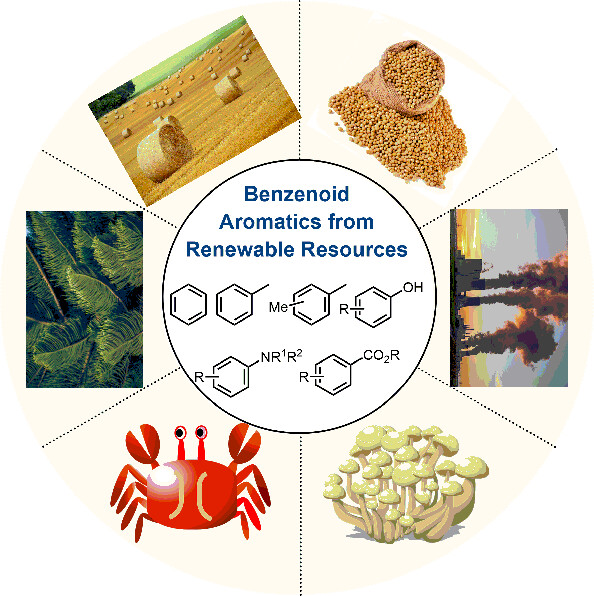
ABSTRACT: In this Review, all known chemical methods for the conversion of renewable resources into benzenoid aromatics are summarized. The raw materials that were taken into consideration are CO2; lignocellulose and its constituents cellulose, hemicellulose, and lignin; carbohydrates, mostly glucose, fructose, and xylose; chitin; fats and oils; terpenes; and materials that are easily obtained via fermentation, such as biogas, bioethanol, acetone, and many more. There are roughly two directions. One much used method is catalytic fast pyrolysis carried out at high temperatures (between 300 and 700 °C depending on the raw material), which leads to the formation of biochar; gases, such as CO, CO2, H2, and CH4; and an oil which is a mixture of hydrocarbons, mostly aromatics. The carbon selectivities of this method can be reasonably high when defined small molecules such as methanol or hexane are used but are rather low when highly oxygenated compounds such as lignocellulose are used. The other direction is largely based on the multistep conversion of platform chemicals obtained from lignocellulose, cellulose, or sugars and a limited number of fats and terpenes. Much research has focused on furan compounds such as furfural, 5-hydroxymethylfurfural, and 5-chloromethylfurfural. The conversion of lignocellulose to xylene via 5-chloromethylfurfural and dimethylfuran has led to the construction of two large-scale plants, one of which has been operational since 2023.
摘要:本文了综述所有已知的将可再生资源转化为苯环芳烃的化学方法。所考虑的原材料包括二氧化碳、木质纤维素及其组分(纤维素、半纤维素和木质素)、碳水化合物(主要是葡萄糖、果糖和木糖)、甲壳素、脂肪和油脂、萜烯,以及通过发酵易得的物质,如沼气、生物乙醇、丙酮等。研究方向大致可分为两类。一类是常用的催化快速热解技术,该技术在高温下(根据原料不同,温度在300至700 ℃之间)进行,会生成生物炭、气体(如一氧化碳、二氧化碳、氢气和甲烷)以及一种主要由芳烃组成的烃类油品。当使用明确的小分子(如甲醇或己烷)时,该方法的碳选择性可以相当高,但当使用高度含氧化合物(如木质纤维素)时,碳选择性则较低。另一类方向主要基于从木质纤维素、纤维素或糖类以及少数几种油脂和萜烯中获得的平台化学品的多步转化。许多研究集中在呋喃类化合物上,例如糠醛、5-羟甲基糠醛和5-氯甲基糠醛。从木质纤维素出发,经由5-氯甲基糠醛和二甲基呋喃转化为二甲苯的工艺,已促成两座大型工厂的建设,其中一座自2023年起已投入运行。