A.K.K. Vikla, K. Koichumanova, Songbo He*, K. Seshan
Green Energy & Environment, 9(4), 777-788
https://doi.org/10.1016/j.gee.2022.09.002
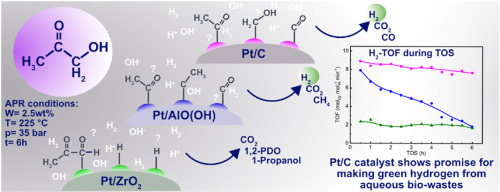
ABSTRAC: Aqueous-phase reforming (APR) is an attractive process to produce bio-based hydrogen from waste biomass streams, during which the catalyst stability is often challenged due to the harsh reaction conditions. In this work, three Pt-based catalysts supported on C, AlO(OH), and ZrO2 were investigated for the APR of hydroxyacetone solution in a fixed bed reactor at 225 °C and 35 bar. Among them, the Pt/C catalyst showed the highest turnover frequency for H2 production (TOF of 8.9 molH2 molPt−1 min−1) and the longest catalyst stability. Over the AlO(OH) and ZrO2 supported Pt catalysts, the side reactions consuming H2, formation of coke, and Pt sintering result in a low H2 production and the fast catalyst deactivation. The proposed reaction pathways suggest that a promising APR catalyst should reform all oxygenates in the aqueous phase, minimize the hydrogenation of the oxygenates, maximize the WGS reaction, and inhibit the condensation and coking reactions for maximizing the hydrogen yield and a stable catalytic performance.
摘要: 水相重整(APR)是从废弃生物质原料中生产生物基氢能的重要工艺。然而,在苛刻的反应条件下,催化剂的稳定性通常面临严峻挑战。本研究在固定床反应器中,于225 ℃、35 bar条件下,考察了以C、AlO(OH)和ZrO₂为载体的三种铂基催化剂对羟基丙酮溶液的水相重整性能。结果表明,Pt/C催化剂表现出最高的产氢转换频率(8.9 molH₂ molPt⁻¹ min⁻¹)和最长的催化稳定性。而AlO(OH)和ZrO₂负载的铂基催化剂则因发生消耗氢气的副反应、积碳及铂烧结等问题,导致产氢效率低下且催化剂快速失活。基于提出的反应路径分析表明,理想的水相重整催化剂应具备以下特性:能够完全转化液相中的含氧有机物;最大限度地减少含氧有机物的加氢反应;促进水煤气变换反应;同时抑制缩合和结焦反应,从而实现高产氢率和稳定的催化性能。